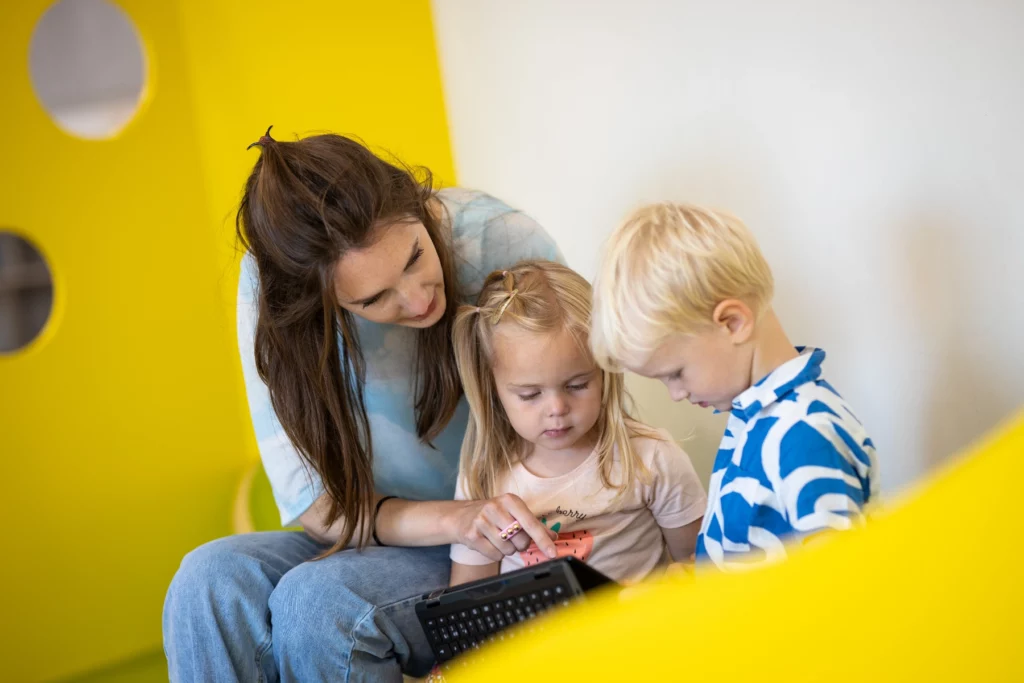
A preschool classroom is one of the most complex environments imaginable. A single teacher, twenty-five children aged three to six, a dozen different play corners, and a constant flow of activity. In that chaos, some children inevitably go unseen. The quiet one who always retreats to the same corner or activities. The child who can never seem to stay focused for more than ten minutes. The one whose eyes were red that morning, but who never said why.
Smart Symbols was built for exactly that teacher, in exactly that classroom.
What Smart Symbols Does
Smart Symbols is a classroom management app for early education. It replaces the physical planning board (magnets, lost name cards) with a digital choice board on a screen. Children pick their activity or play corner by dragging their personal symbol. The app then records automatically: who chose what, for how long, and with whom.
From there, everything comes together. Teachers can observe and take notes in real time, by text or photo, linked to a child and a learning goal. Children give feedback through a simple smiley screen. The app shows patterns that would otherwise take hours to track by hand: which corners are avoided, which children always make the same choice, how friendships and social dynamics develop. Planning, goals, observations and evaluations all in one place.
The Impact on Teachers
The most immediate effect is calm. “It offers enormous peace in the classroom,” says Chloe, a teacher in the Netherlands. “Instead of crowding around a small board, the overview now hangs large in the middle of the class.” Children stopped jostling. And Chloe found herself free to observe rather than manage.
But the bigger change is in what teachers now see. Griet, a kindergarten teacher in Muizen (Belgium) and a Smart Symbols ambassador, noticed through her dashboard that children were losing interest in two play corners after 14 to 20 minutes. She added new materials and more varied tasks enriching the activity: the engagement rose measurably. “Data helps me truly understand the interests of my pupils and adapt my offering accordingly,” she says.
The Impact on Children
Children are active participants, not just subjects of observation. They choose their own activities, photograph their own work, and reflect on how they felt. This supports what early education is meant to build: independence, self-awareness, and a sense of ownership over learning.
The emotional side is particularly important. Smart Symbols includes an emotion board: children show how they feel through a simple visual at the start or end of the day. As co-founder David Minne explains: “Teachers tell us that within days, they have enormous amounts of information they never had before. A conflict on the playground, a child who is sad. It can be shared on the board and discussed in class.” For young children who find it hard to put their feelings into words, this matters. Small signals are picked up early and can be addressed quickly.
The Impact on Parents
“I am truly super enthusiastic,” says Ellen, a kindergarten teacher in Geraardsbergen. “Smart Symbols lightens the work. All data is connected. Now I open Smart Symbols during parent meetings and the conversation is much more focused on the child itself.”
Instead of a general impression, a teacher can show exactly which activities a child chooses, what interests they have, what should parents stimulate at home? Photos linked to learning goals make progress visible and concrete. This also makes meetings with specialists and care teams more focused and better informed.
Evidence and Growth
Smart Symbols currently reaches over 10,000 pupils across Belgium and the Netherlands, with a growing presence internationally. The team wants to go beyond stories and testimonials and build a solid evidence base. Smart Symbols is therefore taking part in a research programme in which universities and colleges are studying the tool’s outcomes. And Smart Symbols will also be part of BOOST, a broadly supported framework to systematically test digital learning tools. Co-founder David Minne: “Evidence-based and evidence-informed development of technology is becoming more and more important. We can only applaud that trend. Ultimately, you are working with children; we aim for the best!”